
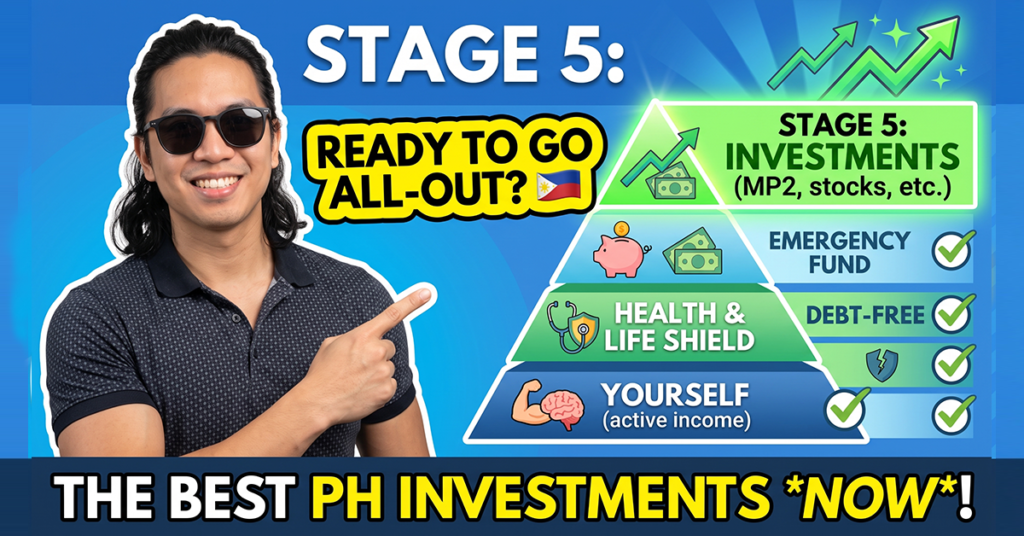
Welcome back to the Freelance to Finance series! Across our previous articles, we systematically built your financial foundation block by block. Before you go all out in investing in the Philippines, you have to build the solid financial foundation stages. You established Stage 1 Healthcare as your wealth shield, set up Stage 2 Income Protection as your family’s failsafe, eliminated high-interest debt leaks in Stage 3, and parked a 3-to-6-month Emergency Fund in high-yield digital banks for Stage 4.
Because your defensive base is fully protected, your primary cash-generating asset—YOU—is completely insulated against life’s sudden shocks. You will never be forced to panic sell your portfolio at a loss during a market downturn just to pay an urgent bill.
Now comes the moment you have been working toward: Stage 5 – Investments.

When your foundation is intact, investing is no longer a high-risk gamble. It becomes a systematic process to build your own money-making machine and let compounding interest work silently in the background. Here is a comprehensive guide to the top investment options in the Philippines—including government programs—along with their pros, cons, and a practical blueprint to manage your wealth wisely.
1. Government-Backed Investment Options
For young professionals and freelancers seeking high security with competitive yields, government-backed investments are the ultimate starting point. Backed by the Republic of the Philippines, these assets carry virtually zero default risk.
Pag-IBIG MP2 (Modified Pag-IBIG II)
A voluntary savings program for active Pag-IBIG members offering tax-free annual dividend earnings with a 5-year maturity period.
- Why It Appeals to Young Adults: You can start with as little as ₱500 per deposit. Historically, dividend rates hover between 6% and 7%+ per year—significantly outperforming traditional bank savings rates.
- Pros: 100% government-guaranteed, dividend earnings are completely tax-free, offers compounded or annual payout options.
- Cons: Capital is locked in for 5 years (early penalty-free withdrawal is restricted to specific life events like critical illness or retirement).
Retail Treasury Bonds (RTBs) & Retail Dollar Bonds (RDBs)
Fixed-income debt instruments issued directly by the Bureau of the Treasury (BTr) to fund national development projects.
- Why It Appeals to Young Adults: Accessible entry threshold (usually starting at ₱5,000) providing guaranteed quarterly or semi-annual interest payouts directly to your bank account.
- Pros: Backed by the national government, predictable income stream, highly liquid (can be sold prior to maturity in the secondary market).
- Cons: Returns are subject to a 20% final withholding tax; yields depend on prevailing market interest rates at the time of issuance.
SSS WISP Plus (Worker’s Investment and Savings Program)
A voluntary retirement-savings scheme managed by the Social Security System (SSS) to supplement regular pension benefits.
- Why It Appeals to Young Adults: Offers tax-free investment growth starting at a minimum contribution of just ₱500, easily managed via the My.SSS online portal.
- Pros: Tax-free earnings, flexible withdrawal rules after a 1-year holding period (subject to extreme early-pullout fees), professionally managed.
- Cons: Returns depend on SSS investment portfolio performance; tailored primarily for long-term retirement rather than short-term cash needs.
2. Market & Commercial Investments for Young Professionals
Once your conservative baseline is established in government vehicles, you can allocate capital toward commercial market investments to capture higher long-term capital growth.
Mutual Funds & UITFs (Unit Investment Trust Funds)
Pooled funds managed by professional fund managers from banks or investment houses that invest in stocks, bonds, or money market instruments.
- Why It Appeals to Young Adults: Seamlessly accessible through everyday mobile apps like GCash (GInvest), Maya, BDO, and BPI without requiring stock picking expertise.
- Pros: Instant diversification, managed by financial professionals, low entry barrier (starting at ₱50 to ₱1,000).
- Cons: Management fees (expense ratios) reduce total returns; asset values fluctuate daily based on market conditions.
Philippine Stock Market (PSE) & Index Funds
Direct stock ownership in publicly traded Philippine corporations or passive tracking of the 30 largest companies via the Philippine Stock Exchange Index (PSEi).
- Why It Appeals to Young Adults: High growth ceiling and dividend potential from top domestic enterprises (e.g., SM, Ayala, Jollibee, BDO) using online brokers like COL Financial, First Metro Sec, or Maya Stocks.
- Pros: Highest historical return potential over long horizons, dividend income, capital gains tax exemption upon sale through licensed brokers.
- Cons: High price volatility, requires emotional discipline, risk of short-term losses during economic downturns.
Real Estate Investment Trusts (REITs)
Companies that own or operate income-generating real estate properties. By law (Republic Act 9856), REITs must distribute at least 90% of their distributable income to shareholders as dividends.
- Why It Appeals to Young Adults: Allows you to earn passive income from prime commercial real estate (malls, offices, logistics hubs) without buying physical property.
- Pros: High quarterly dividend yields, tradeable on the stock market like regular shares, lower entry cost than physical real estate.
- Cons: Sensitive to interest rate hikes and commercial occupancy fluctuations.
US Equity Feeder Funds & Global Index ETFs
Locally structured funds offered by Philippine banks that pool Philippine Pesos to invest in international master funds tracking global indices like the S&P 500 or Nasdaq 100.
- Why It Appeals to Young Adults: Direct exposure to global technology leaders (Apple, Microsoft, Nvidia, Amazon) through local Philippine bank accounts.
- Pros: Geographic diversification outside the PH economy, hedge against Peso depreciation, historical long-term growth track record.
- Cons: Exposed to foreign currency volatility (USD/PHP exchange rates) and global macroeconomic shocks.
3. Investment Vehicles at a Glance
| Investment Vehicle | Risk Level | Minimum Start | Target Horizon | Primary Benefit |
| Pag-IBIG MP2 | Low | ₱500 | 5 Years | Tax-Free Government Yield |
| Retail Treasury Bonds | Low | ₱5,000 | 3 – 5+ Years | Guaranteed Periodic Interest |
| SSS WISP Plus | Low–Moderate | ₱500 | 1 – 10+ Years | Tax-Free Retirement Growth |
| UITFs / Mutual Funds | Moderate | ₱50 – ₱1,000 | 3 – 5 Years | Hands-Free Diversification |
| REITs | Moderate–High | ~₱1,000 | 3 – 7+ Years | Regular Dividend Cash Flow |
| PSE Stocks / PSEi | High | ₱1,000 | 5 – 10+ Years | Maximum Long-Term Growth |
| US Feeder Funds | High | ₱1,000 | 5 – 10+ Years | Global Market Diversification |
4. Practical Blueprint: How to Wisely Handle Investments
Going all-out on investments does not mean gambling your savings blindly. Follow these rules to handle your portfolio:
- Match Your Timeline to Asset Class: Keep short-term goals (1 to 3 years) in conservative options like MP2 or RTBs. Reserve high-volatility assets like PSE stocks, REITs, and US feeder funds for long-term targets (5 to 10+ years).
- Practice Dollar-Cost Averaging (DCA): Avoid trying to time the market. Set an automated transfer to invest a fixed amount every payday, regardless of market peaks or dips.
- Diversify Across Asset Classes: Never put 100% of your money into a single stock or asset class. Balance your portfolio across government-backed instruments, domestic equities, REITs, and international index funds.
- Steer Clear of Unregulated High-Yield Scams: If an entity promises “guaranteed” monthly returns of 10% to 30%, it is a financial trap. Real investing requires patience and market awareness.
- Counter Lifestyle Creep: As your freelance rates or career salary grow, scale your monthly investment allocations upward proportionally rather than inflating non-essential spending.
Building wealth is not a quick sprint—it is the disciplined reward of protecting your money-making machine first. Now that your foundation is rock-solid, start allocating capital today and let compound growth turn your earnings into long-term financial freedom.
Join the Freelance to Finance Community! When Stages 1 through 4 are fully intact, your money-making machine is completely insulated. Ready to reach the peak of the pyramid and start multiplying your wealth? Follow our social media accounts to stay updated on the next installment of the series!
Join the Financial Literacy Campaign and get a FREE personal accident insurance!


IMG is the ultimate destination for empowering financial literacy among Filipinos. We believe that knowledge is the key to financial freedom, and our mission is to equip all Filipinos with the tools and insights needed to make informed financial decisions.
In line with IMG’s 30 Million Financially Educated Families by 2030 Financial Literacy Campaign, We are giving FREE PAI (Personal Accident Insurance) with P20,000 1 year coverage for Non IMG Members.
Simply follow these instructions:
1. Register here or scan the QR code above. Make sure that your email address is active. Provide your beneficiaries and just choose “revocable” by default.
2. You will receive an email notification. Confirm your subscription in the link provided.
3. Register five (5) persons whom you want to share the Free P20,000 Personal Accident Insurance, as well.
4. Application Form will be sent to your email address, for your completion. Make sure all details are correct to avoid technical delays.
5. Get your approved Personal Accident Insurance policy from IMG-MBLife. Congratulations!!

Disclaimer: This is 100% FREE. We don’t solicit money; our email thread should not ask you to pay for any amount.